
What is the Autumn Equinox? A beginner’s guide to its history, meaning, and celebration
This blog post was written by James Mead and originally featured on the blog on his website Wild Selkie Wellbeing
The turning of the seasons has always been something of a time of wonder, reflection and ritual. In the UK where we are starting to see Celtic and Pagan traditions making a bigger appearance in the landscape, the Autumn Equinox holds that place in the cycle of the year alongside the Spring Equinox. It marks a moment of perfect balance – day and night are equal, and in the case of the Autumn Equinox, the darker half of the year begins its slow ascent. For those starting to explore the Wheel of the Year, the Autumn Equinox is a doorway to help deepen your connection with nature, community and the rhythms of your own life.
Whether you’re completing new to living on the Wheel of the Year or are just curious about what this time of year means, the Autumn Equinox offers a grounding and ascendible way to celebrate the cycles of change.
What’s in a name?
Before going too far, the first thing we need to address are the various names the Autumn Equinox has been given.
Some following certain pathways in the UK will refer to the Autumn Equinox as Herfest . This comes from Old English, where hærfest meant both “harvest” and “autumn”. This was a time to gather in the last of the grain, fruits and nuts before the dark half of the year. Over time, hærfest slowly became our modern word “harvest”, while the Latin term “autumnus” started to replace it as the name of the season, becoming Autumn. Using the term Herfest honours our Anglo-Saxon roots and reminds us of the agricultural rhythms that shaped our lives here in the British isles.
There is a slightly more well-known name for the Autumn Equinox in most modern Pagan circles and that is Mabon. This name is a relatively new and was popularised in the 1970’s by Aidan Kelly. He wanted a set of Celtic-sounding names for the eight festivals of the year and picked Mabon for its aesthetic appeal. The name Mabon itself is the name of a Welsh mythological figure, “Mabon ap Modron”, meaning “Son of Mother”, from the Mabinogion. The deity Mabon himself or his story has no connection to the Autumn Equinox.
Whether you prefer to honour the day as Herfest, Mabon or simply the Autumn Equinox, the essence remains the same – a time of balance, gratitude and gathering before the darker half of the year.
What is the Autumn Equinox
Within our year, there are two equinox’s – the Spring Equinox and the Autumn Equinox – they are the points in the year when day and night are in perfect balance. It usually falls between the 21st and the 23rd September in the UK. In 2025 it falls on the 22nd September at 19:20 BST.
After this, the nights start to grow longer than the days, leading us through Autumn and into Winter. It is a time of transition, mirroring the natural world. Leaves begin to fall, crops are harvested, and animals prepare for the leaner months.
The Autumn Equinox on the Wheel of the Year
The Wheel of the Year is a way to view time as cyclical rather than linear. Instead of rushing from one month to another, it honours the ebb and flow in nature. Each celebration on the wheel is both a celebration in its own right, but also part of the larger journey of birth, growth, harvest and renewal.
The Autumn Equinox represents harvest and balance. It is the second harvest festival following Lughnasadh and marks the mid-point of Autumn. It symbolises gathering in what we have sown – not only in the fields, but also in our lives. It is a time of gratitude for the abundance of summer, but also a reminder of the impermanence of all things.
It invites us to pause at the point of balance – light and dark, growth and decline, outer activity and inner reflection. In many traditions, it is also a time of thanksgiving, offering gratitude to the land, the ancestors and the turning of the seasons.
Why celebrate the Autumn Equinox?
For beginners, celebrating the Autumn Equinox can feel grounding and healing because it ties you into the rhythms of nature happening around you. Instead of resisting the darker evenings or the end of summer, you step into alignment with them. We start to acknowledge that along with natures ebbs and flow, we have the same in our lives. This is a time to start to slow down, a sharp contrast to how modern society expects us to keep moving at the same pace throughout the year.
How to celebrate the Autumn Equinox: A Beginners Guide
You don’t need elaborate rituals or specialised tools to celebrate the move through the wheel. Start simply and let your intuition guide you. Here are some beginner friendly practices you could try:
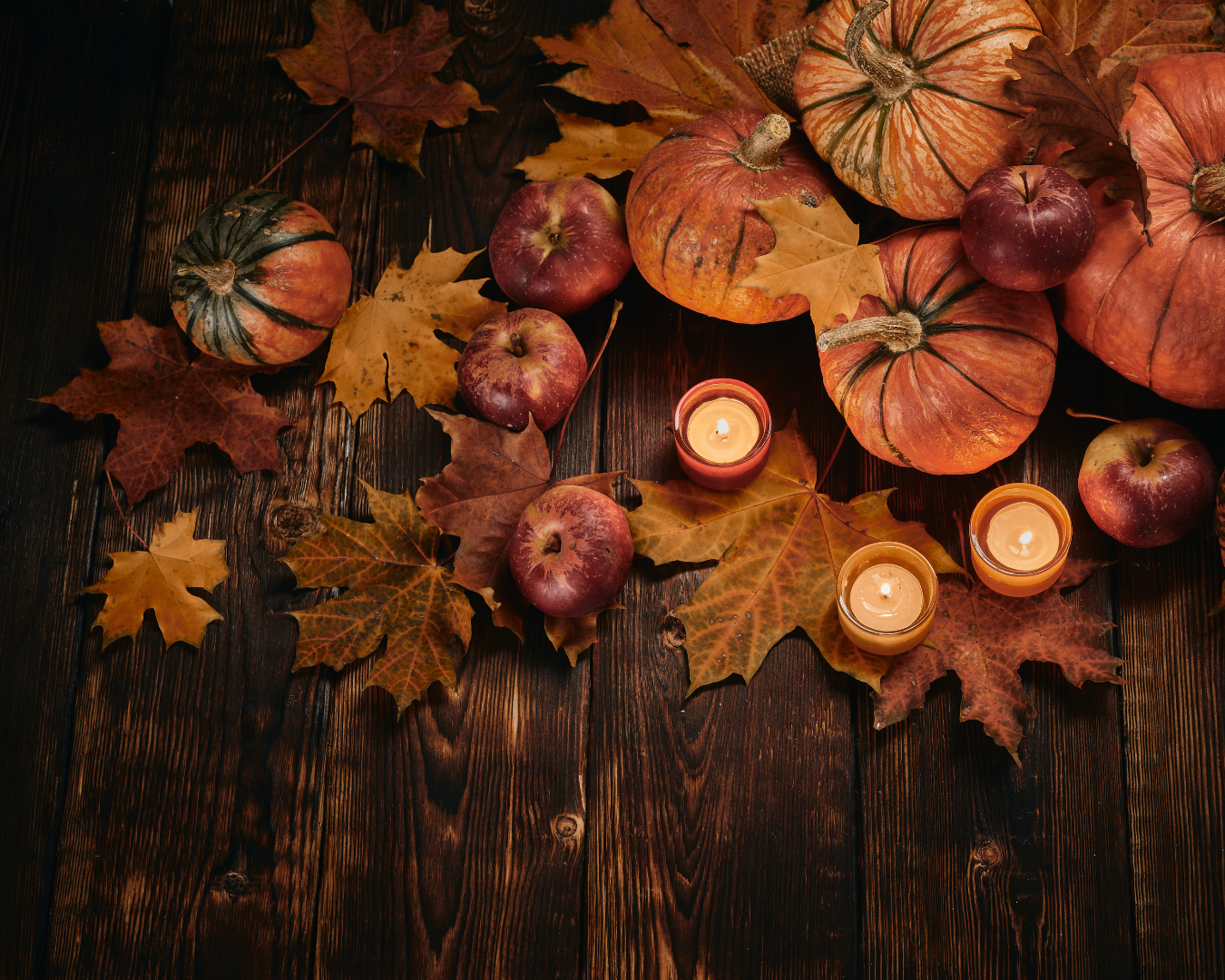
- Create a seasonal altar – An altar is simply a dedicated space where you can honour the season. Gather items from nature – colourful autumn leaves, acorns, conkers, apples, pumpkins and seasonal flowers like chrysanthemums. Add candles to represent the balance of light and dark.
- Cook a harvest feast – The Autumn Equinox is a harvest festival, so food is central to its celebration. Cook a meal using seasonal produce such as squash, apples, pears, blackberries or root vegetables. Even something as simple as an apple crumble or a simple vegetable stew can feel like an offering. Share it with loved ones and eat it mindfully.
- Practice gratitude – Spend some quiet time and write down everything you feel grateful for from the past few seasons. These might be personal achievements, experiences, or lessons learned. Gratitude is one of the simplest but most transformative ways to celebrate the equinox.
- Go for a walk in nature – Take a mindful walk in the woods, by the sea or in the park. Leave your phone at home or on silent. Collect fallen leaves, conkers or seeds. Notice the change in colours of the plants, the earlier sunsets and the coolness in the air. By simply watching and noticing these changes, you start to ground yourself in the present moment.
- Offer thanks to the land – If you have access to a garden or outdoor space, make a small offering of food, seeds or water to the earth. Reciprocity is something we do not do enough of in this modern world. This act symbolises our gratitude to the land for helping us live and survive. True, we are not as dependent as our ancestors were, but it still provides our food and provides raw materials to help us live and survive.
Bringing it all together
Celebrating the Autumn Equinox (or any celebration on the wheel) doesn’t require belonging to a specific tradition or following strict rules. It’s about noticing, honouring and aligning with natural balance that this time in the year embodies.
For beginners, the most important thing is to stay authentic. Whether you plan an elaborate ritual to celebrate the time of year, or just do simple acts such as lighting a candle, eat an apple or take a walk amongst the autumn leaves, these acts are powerful ways of weaving yourself into the cycles of the land.
The equinox reminds us that life is not about endless growth, but about balance, harvest and release. By pausing to honour this move through the year, you may find yourself able to notice and navigate your own cycle of changes.
As the nights grow longer and the air cools, may this Autumn Equinox be a time of reflection, balance and gratitude. Whether you celebrate with a feast, a quiet candlelit meditation or a walk in the woods, know you are stepping into alignment with an ancient rhythm – one that has been honoured on these lands for thousands of years.
That was a wonderful read. Thanks James
Thanks Tina 🙂